How Do Mallard Ducks Migrate and How to Track Their Patterns
Tracking the migration patterns of mallard ducks can feel overwhelming if you’re just starting out. You’re not alone—many wildlife enthusiasts and bird watchers struggle with understanding when and where these ducks travel each year. Whether you’re hoping to observe their journeys or contribute to conservation efforts, knowing how to follow their movements is key.
You’ll see mallard ducks migrate annually from late September to November, moving from northern wetlands to find food and breeding spots. They navigate using the sun, stars, landmarks, and Earth’s magnetic field while avoiding predators and harsh weather challenges.
You can track their journeys using lightweight GPS and satellite tags, which reveal routes, stopovers, and behaviors. Citizen scientists also aid by sharing observations. If you investigate further, you’ll uncover how these insights support their conservation and survival.
Key Takeaways
- Mallard ducks migrate from northern wetlands to warmer areas between late September and November to find food and suitable breeding sites.
- They navigate using cues like the sun, stars, landmarks, and Earth’s magnetic field to make their long-distance travel accurate.
- Wetlands are critical stopover sites where the ducks rest, eat, and find protection during their migration journey.
- GPS and satellite telemetry devices help track their real-time locations, flight speeds, and how long they stay at each stopover to study migration patterns.
- Citizen scientists also play a big role by sharing observations of sightings and behaviors, which supports conservation and helps monitor migration.
Why Do Mallard Ducks Migrate Every Year?
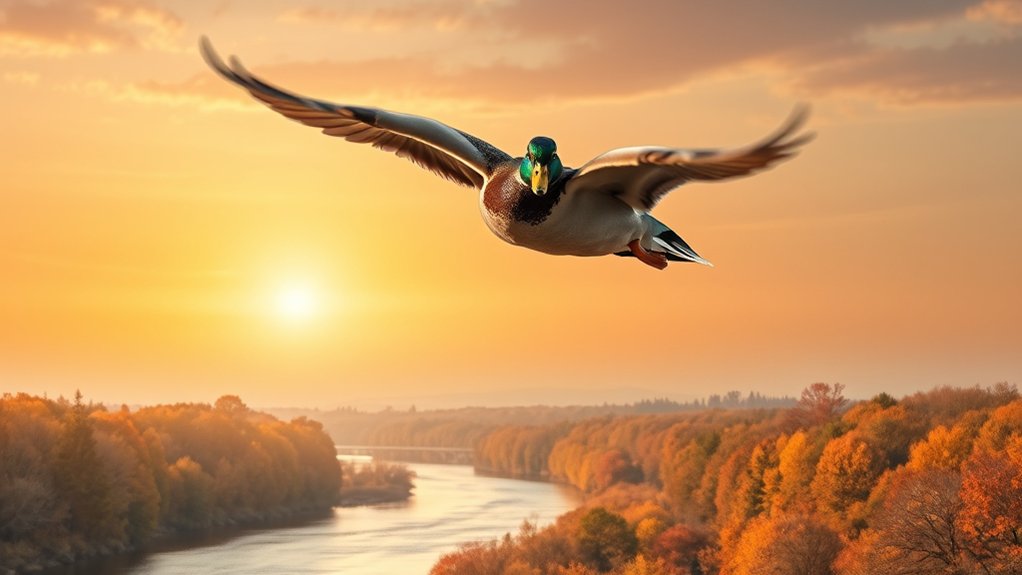
Although mallard ducks can adapt to various environments, they migrate every year primarily to find food and suitable breeding conditions as seasons change. You’ll notice that their mallard diet shifts depending on availability. During colder months, food becomes scarce, so they move to areas where aquatic plants, insects, and small fish are abundant. This dietary flexibility helps them survive harsh conditions.
You’ll also see their nesting behavior influence migration. Mallards need safe, calm waters with plenty of cover to lay eggs and raise ducklings. As temperatures drop and wetlands freeze, these conditions disappear, pushing them to relocate to warmer spots. Understanding these reasons helps you appreciate why mallards don’t just wander; they follow a purposeful pattern driven by survival and reproduction needs. So, when you track their movements, remember it’s all about securing the right food and environment for the next generation.
When and Where Do Mallards Begin Their Migration?
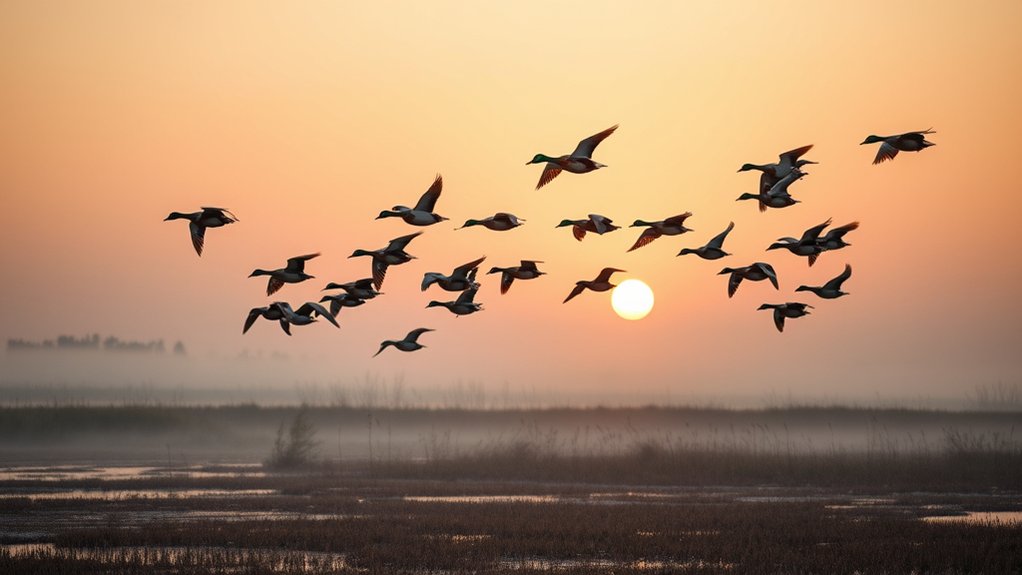
As the seasons change and food sources dwindle, mallard ducks start preparing for their migration. You’ll notice their feeding habits shift. They eat more aggressively to build energy reserves. Their nesting behaviors also change as they finish raising ducklings and get ready for the journey ahead.
Here’s when and where mallards begin their migration:
Discover the timing and locations where mallards begin their seasonal migration journeys.
- Timing: Usually late September to November, once daylight shortens and temperatures drop.
- Location: They start from breeding grounds in northern wetlands, lakes, and marshes.
- Feeding: Before leaving, mallards increase foraging in agricultural fields and wetlands to fatten up.
- Grouping: They gather in large flocks near open water, where food and safety are plentiful.
How Mallards Navigate Their Migration Routes
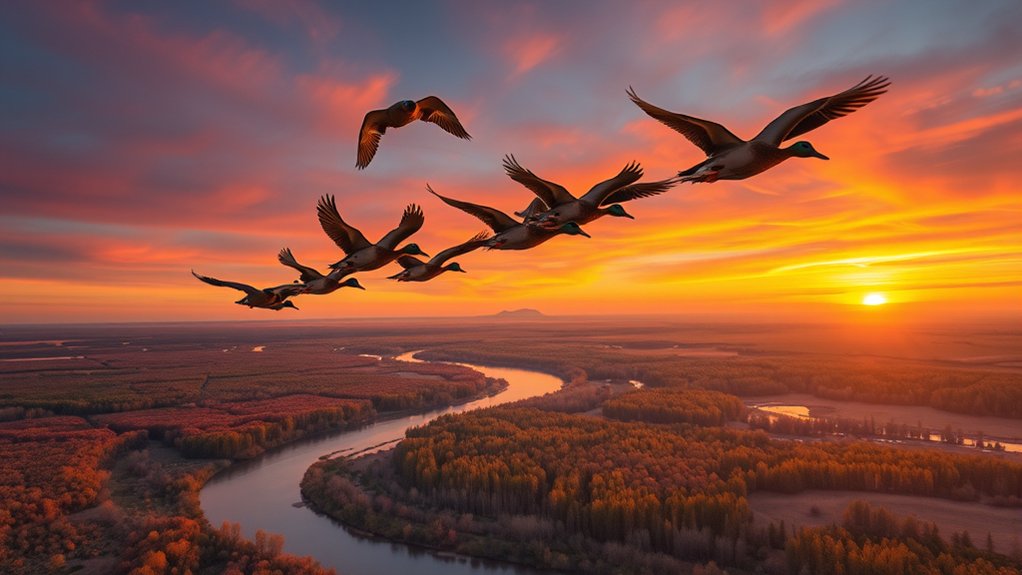
You’ll find that mallards use natural navigation techniques to find their way during migration. They rely on environmental cues like the sun, stars, and landmarks to stay on course. Plus, magnetic fields play a key role in guiding their long journeys. It’s pretty amazing how they can pick up on these subtle signals and keep heading in the right direction. So, next time you see a flock flying overhead, remember there’s a lot going on behind the scenes to help them get where they’re going.
Natural Navigation Techniques
When mallard ducks set off on their long journeys, they rely on remarkable natural navigation techniques to find their way. You can observe how their feather coloration helps in recognizing fellow travelers during migration, ensuring the flock stays united. Their nesting behaviors also play a role, as returning to familiar breeding grounds guides them seasonally.
Here are four key natural navigation techniques mallards use:
- Visual landmarks: They memorize rivers, lakes, and mountains to chart their route.
- Sun positioning: The sun’s angle helps them maintain direction during daylight.
- Magnetic field sensitivity: Mallards detect Earth’s magnetic field to orient themselves.
- Memory of past migrations: Experience from previous trips sharpens their navigation skills.
Understanding these techniques helps you appreciate the complexity behind mallard migration.
Environmental Cues Utilized
Mallard ducks don’t rely solely on their internal navigation skills. They also respond to environmental cues that guide them along migration routes. When you track their movement, you’ll notice they use landmarks like rivers, lakes, and coastlines to stay on course.
You’ll see they avoid areas with heavy urban development because these zones disrupt natural pathways and increase predation risks. Mallards tend to select stopover sites offering shelter and food, which helps them avoid predators while resting.
You can observe how they adjust routes seasonally, steering clear of risky environments and favoring safer corridors. Understanding these cues helps you predict where mallards might appear during migration, making your tracking efforts more effective and insightful.
Role Of Magnetic Fields
Although environmental cues play an essential role, these ducks also rely heavily on Earth’s magnetic fields to navigate their migration routes. Mallards use magnetic orientation to maintain their direction over long distances, even when visual landmarks aren’t available.
Here’s how magnetic fields guide them:
- Detection: Mallards sense Earth’s magnetic field through specialized receptors.
- Navigation: They use this magnetic input to orient themselves accurately.
- Consistency: Magnetic orientation helps them stay on course during cloudy or dark conditions.
- Adaptation: Mallards can recalibrate their internal compass if magnetic fields shift.
What Challenges Do Mallards Face During Migration?
Because migration demands long flights and precise timing, ducks face numerous challenges along the way. You’ll see mallards constantly on alert for predator threats, such as hawks and foxes waiting near stopover sites. These dangers force them to stay vigilant and sometimes alter their routes to avoid risky areas.
At the same time, food availability plays a vital role in their survival. You’ll notice that mallards depend on finding enough nutritious food to fuel their energy-hungry journey. If wetlands dry up or food sources dwindle, their migration can be delayed or become far more exhausting.
You might also observe that limited food access affects their ability to build fat reserves necessary for long flights. Together, predator threats and fluctuating food availability shape the mallards’ migration success, forcing them to adapt constantly. Understanding these challenges helps you appreciate the resilience mallards show every migration season.
How Weather and Climate Influence Mallard Migration
You’ll notice that changing weather patterns play a big role in when and where mallards migrate each year. Sudden storms or temperature shifts can force them to alter their routes or timing. And on top of that, climate change is gradually reshaping their traditional migration habits. So, it’s becoming harder to predict their movements.
Weather Patterns Affecting Migration
When cold fronts sweep through their habitats, mallard ducks adjust their migration timing and routes to avoid harsh conditions. You’ll notice weather patterns heavily influence their decisions, especially since they aim to minimize energy use and predation risks.
Here’s how weather affects their migration:
- Strong winds can delay departures or push ducks off course, making them seek safer, more sheltered paths.
- Sudden storms force them to land earlier or find protected stopovers.
- Urban development changes local weather and can create unexpected microclimates, influencing duck stopover choices.
- Temperature drops signal ducks to begin migration earlier to avoid frozen wetlands.
Climate Change Impact
As climate change reshapes global weather patterns, mallard ducks face new challenges in their migration routes and timing. You’ll notice shifts in when and where they travel, as warmer temperatures alter food availability and stopover sites.
Urban encroachment worsens these impacts by reducing natural habitats, forcing ducks to adapt to more crowded and sometimes hazardous environments. Pollution effects, like contaminated water sources, further threaten their health and survival during migration.
When tracking mallard patterns, you’ll see increased variability year to year, making it harder to predict their movements. Understanding how climate change interacts with urban growth and pollution helps you appreciate the complexity of mallard migration and highlights the need for conservation efforts that address these interconnected threats.
Why Wetlands Are Critical Stopover Sites for Mallard Migration
Because mallard ducks rely on long migratory journeys, wetlands serve as essential rest and refueling spots along their routes. When you understand why wetlands matter, you’ll see how wetland preservation and habitat restoration directly support mallard survival. These areas offer crucial resources that mallards need to continue their migration effectively.
Wetlands are vital rest stops that provide mallards with the resources needed for successful migration.
Here are four reasons wetlands are critical stopover sites:
- Food Supply Wetlands provide abundant aquatic plants and invertebrates, fueling mallards for the next leg.
- Water Access Ducks need clean water to drink, bathe, and forage, making wetlands perfect for hydration and hygiene.
- Shelter and Safety Dense vegetation shields mallards from predators and harsh weather during vulnerable rest periods.
- Breeding Grounds Some wetlands also serve as breeding sites, linking migration with reproduction.
What Tech Tracks Mallard Ducks in the Wild?
You can track mallard ducks using GPS devices that attach to their bodies. These gadgets give real-time location data, so you always know where the ducks are.
Researchers also use satellite telemetry methods, which are great for monitoring their long-distance migration patterns.
With these tools, you get accurate insights into when and where mallards travel, making it easier to study their behavior in the wild.
GPS Tracking Devices
When tracking mallard ducks in the wild, GPS tracking devices offer the most accurate way to monitor their migration routes and behaviors. These small, lightweight gadgets attach to ducks without affecting their wing morphology, allowing you to study mallard behavior in detail.
Here’s why GPS devices are essential:
- Provide real-time location data, showing exact migration paths.
- Record movement speed and stopover times, revealing behavioral patterns.
- Store data for long periods, enabling seasonal and yearly comparisons.
- Offer precise tracking without disturbing natural activities.
Using GPS tracking devices lets you uncover how wing morphology influences flight endurance and route choices. With this tech, you gain a clear picture of mallard migration, which helps conservation efforts and deepens your understanding of these adaptable birds.
Satellite Telemetry Methods
Although GPS devices provide detailed local data, satellite telemetry methods expand your ability to track mallard ducks over vast distances and remote areas. These systems use transmitters that send location data to satellites, allowing you to monitor migration routes, feather coloration changes linked to molting, and nesting behaviors in real-time. This tech offers insights beyond traditional banding or ground tracking.
| Feature | Benefit | Application |
|---|---|---|
| Satellite Uplink | Global coverage | Long-distance migration |
| Lightweight Tags | Minimal interference | Natural feather coloration |
| Solar Power | Extended operation | Continuous behavior tracking |
| Data Frequency | Frequent updates | Nesting behavior monitoring |
| Geofencing Alerts | Automated location alerts | Protecting breeding sites |
Satellite telemetry helps you understand mallards’ life cycles and migration with precision.
How GPS and Satellite Tags Reveal Migration Patterns
Because mallard ducks often travel thousands of miles during migration, researchers rely on GPS and satellite tags to track their movements accurately. These devices reveal detailed insights into mallard behavior, including how their migration links to mating rituals and habitat use.
Here’s how GPS and satellite tags help you understand their migration patterns:
- Real-time tracking: You get up-to-date location data, showing exact routes and stopover sites.
- Behavioral insights: The tags record movement patterns that highlight changes during mating rituals and breeding seasons.
- Long-distance data: They provide extensive tracking across continents, capturing the full migration journey.
- Habitat preferences: You can identify key wetlands and resting spots vital for survival and reproduction.
How Birdwatchers and Citizen Scientists Help Track Mallards
While scientists use advanced technology to track mallard migrations, birdwatchers and citizen scientists play an equally significant role by reporting sightings and contributing valuable data. You can help by noting details like feather coloration, which varies between males and females and changes seasonally. This makes it easier to identify individual ducks.
Observing nesting behavior also provides critical insights into breeding success and habitat preferences.
How Tracking Mallard Migration Supports Conservation Efforts
Why does tracking mallard migration matter for conservation? When you follow their journeys, you gain critical insights into how these ducks adapt to changing environments. Understanding their migration patterns helps protect essential habitats that support their mallard diet and nesting habits.
Here’s how tracking supports conservation efforts:
- Identifies key wetlands and stopover sites essential for feeding and breeding.
- Reveals changes in mallard diet preferences due to habitat shifts or climate change.
- Informs habitat restoration projects that accommodate nesting habits and improve survival rates.
- Monitors population health to detect threats like pollution or habitat loss early.
Frequently Asked Questions
What Do Mallard Ducks Eat During Migration?
During migration, mallard ducks adapt their feeding habits to fuel their long journey. You’ll find they prefer a varied diet, including aquatic plants, seeds, and small invertebrates.
Their dietary preferences shift depending on availability, so they might eat more grains or insects when passing through agricultural areas. You can expect them to forage frequently to maintain energy, focusing on high-protein and carbohydrate-rich foods that support their endurance during migration.
How Long Do Mallard Ducks Typically Live?
You might think mallard ducks live like characters in a Shakespearean play, but they typically live around 5 to 10 years in the wild. Their feeding habits play a big role in their survival, ensuring they stay nourished through seasons.
During breeding behavior, females focus on nesting and raising ducklings, which can be risky and affect lifespan. If you care for their habitat, you help extend their lives naturally.
Do Mallard Ducks Migrate in Groups or Alone?
Mallard ducks usually migrate in groups rather than alone, which is a key part of their mallard behavior. You’ll notice they form loose flocks during migration timing, helping them conserve energy and navigate better.
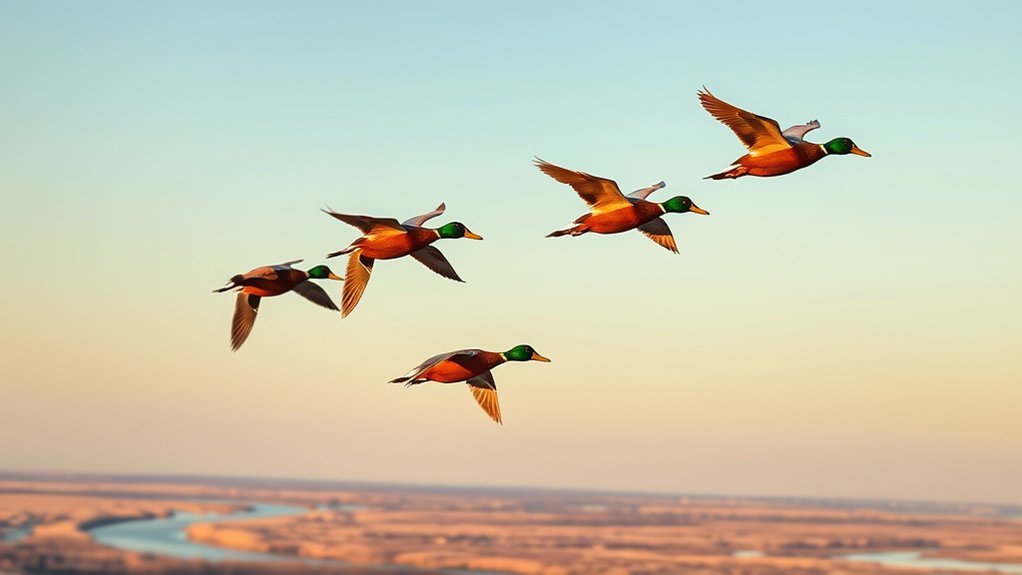
Traveling together also offers protection from predators. So, when you observe mallards flying, you’ll often see a coordinated group moving in a V-formation or loose clusters, showcasing their social migration habits.
How Do Mallard Ducklings Learn Migration Routes?
Think of migration timing as a clock ticking in nature’s rhythm. You’ll notice mallard ducklings learn migration routes by closely following their mother, absorbing her movements and decisions.
Their learning behaviors are like a student shadowing a teacher, imprinting essential survival skills. You’ll see they rely on instinct combined with this hands-on guidance, gradually mastering when and where to fly, ensuring they stay on course during their long journeys.
Can Urban Environments Impact Mallard Migration?
Yes, urban environments can impact mallard migration. You’ll notice that their urban adaptation sometimes leads them to stay in cities year-round, reducing traditional migration.
Habitat fragmentation caused by development disrupts their natural routes and resting spots, forcing you to track altered patterns. By observing these changes, you can understand how mallards adjust their behavior, often relying more on urban water bodies and less on distant wetlands during migration seasons.
Conclusion
As you follow the mallard’s journey, imagine each duck as a feather carried on the wind—resilient, purposeful, and connected. Their migration maps not just a path across skies but a story of survival and harmony with nature.
By tracking their flight, you become part of this living tapestry, helping protect their future. So keep watching, tagging, and learning because every feather in the sky counts toward the vibrant mosaic of life and understanding how mallard ducks migrate.